Sunday, August 17, 2014

3 IDIOTS (Rajkumar Hirani, 2009)


           Co-written, edited and directed by Rajkumar Hirani, 3 Idiots is a 2009 Bollywood dramedy (comedy-drama) film that is loosely based on Chetan Bhagat’s novel Five Point Someone. This film is primarily a tale of friendship as it follows the story of three friends, namely Farhan, Raju and Rancho, that met during their time at the fictional, Imperial College of Engineering. The film starts a decade after their graduation, with Farhan and Raju desperately in search of Rancho after receiving information regarding his whereabouts following his disappearance 10 years prior.

            While the duo is hot on the trail of their missing friend, their meeting with Rancho and their college life are told in intermittent flashbacks. We learn that each of the trio had different reasons for pursuing a diploma in engineering. Both Farhan and Raju were doing it out of feeling responsible for their families such as having to fulfill an expectant father’s wishes and improve a financially-starved family’s situation. Not only that, harsh realities of India’s dog-eat-dog, mindless rote-learning education system that contribute to the rising suicide rate among youngsters in the country are unveiled (Phani Sarma & Kavya, 2010, p. 3). This is where the talented, free spirited Rancho comes in and inspires the people around him as well as the viewers with his optimistic outlook on life.

            Serious talk about the film’s underlying message aside, the conventions of popular Indian cinema will be the main topic of discussion in this essay. Trademark conventions include characters randomly bursting into song and dance and exaggerated pantomimic style of acting (“Bollywood”, 2011, para. 1), in which pantomimic refers to the technique of expressing emotion, actions, feelings, etc. through mere gestures (Pantomime, n.d.).

. Recurring interventions in the narrative for song and dance routines is something that is unmistakably Bollywood, and while many general Western viewers regard them as a nonsensical excuse for spectacle and emotion; it is actually of utmost importance in establishing a narrative of spectacles that is always shifting as well as blending moods together (Buchanan & MacCormack, 2008, p. 79). Some in-movie examples are the songs “Give Me Some Sunshine”, “All Izz Well” and “Zoobi Doobi”. The former is a sad song that has a forlorn vibe, which is performed by one of the trio’s friend (Joy) after he is greatly demoralized by the college’s unmerciful dean (ViruS). The latter two are exhilarating songs complete with energetic dance routines, the first one portraying Rancho’s infectious optimism in overcoming life obstacles while the second one depicts Pia (Rancho’s love interest) falling in love with him.  

              The stylized pantomimic style of acting is also subjected to critiques for being much too over-the-top. This, coupled with the little consideration for narrative continuity for the sake of song and dance sequences, gives Western viewers the impression that Bollywood films are generally escapist and exploitative (“Bollywood”, 2011, para. 6). Not only that, local film critics seem to express self-loathing for their country’s ridiculous approach to filmmaking (“Bollywood”, 2011, para. 12). However, it is important to note that these elite upper-middle class critics are not the targeted viewers of the films (“Bollywood”, 2011, para. 14). Whether or not these conventions seem applicable may also vary according to the dominant genre of the movie. In the case of 3 Idiots (Rajkumar Hirani, 2009), the aforementioned conventions are fitting as the film is almost purely a comedy film save some incredibly touching and heart-warming scenes and the romantic subplot.  

            The eccentric approach to filmmaking which Bollywood employs is not without reason. Staying true to its sense of nationalist pride and spirit of kinship (“Bollywood”, 2011, para. 1), the use of pantomimic acting style enhances the emotional impact of the film on its viewers. This enables the Indian viewers to develop a sense of brotherhood solidarity among themselves while watching the film and their collective involvement is retained by bringing in spectacles. It is as if Bollywood films are a form of community bonding.

. Despite having early influences from Hollywood musicals back in the late 1940s (Morcom, 2011, p. 63), Bollywood have long departed from the First World national cinema. While Hollywood strives for realistic, dramatic substance, Bollywood is more inclined to spicing up their narratives with exaggerated pantomimic style acting and spectacles that resonates with the strong value of kinship, duty and social obligation which the middle and lower-class Indians possess. 3 Idiots (Rajkumar Hirani, 2009) is by far one of the most successful Bollywood films to take the world by storm, and if you have not seen it already, there is no doubt that you should do so now.


BIBLIOGRAPHY


Bollywood: The Communal Spirit of India. (2011, August 16). Retrieved August 17, 2014, from http://dafilmschool.wordpress.com/2011/08/16/bollywood-the-communal-spirit-of-india/

Buchanan, I., & MacCormack, P. (2008). Spectacle and Spaghetti Western. In Deleuze and the Schizoanalysis of Cinema (No ed., pp. 75 - 88). New York: Continuum.

Morcom, A. (2011). An understanding between Bollywood and Hollywood? The meaning of Hollywood-style music in Hindi films. British Forum for Ethnomusicology, 10(1), 63-84.

Pantomime [Def. 1]. (n.d.) Dictionary.com. Retrieved August 17, 2014, from http://dictionary.reference.com/browse/pantomimic

Phani Sarma, N., & Kavya, B. (2010). A brief review of the plot. Movie Analysis - 3Idiots, 1-12. Retrieved August 16, 2014, from http://phanisarma.files.wordpress.com/2010/11/assgn_3.pdf


Tuesday, August 12, 2014

Sepet (Yasmin Ahmad, 2004)


           Sepet is a Malaysian 2004 romantic comedy drama film by the brilliant Yasmin Ahmad (who unfortunately passed on in 2009 from massive bleeding in the brain following a stroke). Sepet is the first installment of her critically acclaimed Orked trilogy that has won awards for Best Film. These films challenged racial stereotypes common to Malaysians in addition to exploring the country’s culturally diverse society while depicting the problems faced therein. However, seeing as Malaysia is primarily a Muslim nation and is among the world’s most conservative countries (Ar, 2014), her films are very controversial locally for portraying touchy events and relationships. In fact, Sepet (Yasmin Ahmad, 2004) had been banned until she agreed to make specific cuts issued by Malaysia’s Film Censorship Board.

            ‘Sepet’ roughly translates to ‘slit eyes’ which refers to the kind of eyes that a typical Chinese has. This title is relevant to the film because it follows the love story of a Chinese boy (Ah Loong, also known as Jason) and a Malay girl (Orked). They meet when Orked visits Ah Loong’s pirated VCDs stall at a market, looking for films starring her favorite Japanese-Taiwanese actor, Takeshi Kaneshiro. It is love at first sight for both parties. Orked’s best friend, Lin, realizes this and pokes fun at Jason’s ‘Chinese eyes’ to which Orked expresses that ‘Chinese eyes are the best’. They start going out and faces many social and racial pressures along the way which may very well result in their split.

            Despite the simple plot of a love story, there are numerous underlying messages concerning a multicultural society. First of all, interracial interaction is inevitable in a multiracial country such as Malaysia. One race branches out to many different ethnics, and every ethnic possesses their own cultural heritage, tradition and religious beliefs. In order for different ethnics to live together in harmony, it is important that they learn to respect, appreciate and get along with one another. Citizens have always been encouraged to handle issues of multiculturalism with care even before the release of Sepet (Yasmin Ahmad, 2004), however it seems to me that Malaysians are still confined by stereotypes and are merely tolerating one another instead of actually getting along.

            Yasmin Ahmad approached this issue by challenging her audience to overlook the dissimilarities of race as well as religion between her characters (Al Amin, 2012, p. 2). She used characters that did not just represent typical racial stereotypes of the harmonious Malaysian society. For example, Ah Loong/Jason that resembles a rebellious looking kid or may even be regarded as a gangster with his dyed hair, turns out to be a hopeless romantic that has a passion for reading and writing poetry. Whereas, Orked is seen wearing a viel and reciting the Koran at the beginning of the film but turns out to be an outspoken free spirit that has posters of Takeshi Kaneshiro all over her wardrobe door as well as a passion for Hong Kong films.

            Another underlying issue that is highlighted in the film is the acceptability of interethnic relationships in Malaysia (Ahmad, 2005, para. 4). Lin’s Eurasian-looking Boyfriend sneers at Orked for going out with a yellow-skinned, ‘slit-eyed’ Chinese simply because it goes against their Malay tradition to be involved romantically in anybody outside their race, saying that it will get her into trouble. To which Orked immediately points out that Malay men have been marrying outside their race for many years, yet they have never been questioned the way she is being questioned now. Orked has also pointed out earlier on in the film that due to having been colonized by the British, we are conditioned to believe we are the inferior race and that anything from the West is ‘good’, including their beauty standards. Thus, there will be people like Lin that will have a preference for Western guys. Aforementioned, Orked is scorned for liking a Chinese guy however it might have been more acceptable if it were a Caucasian despite that it would still mean being romantically involved with someone outside their race.

Ultimately, what seems to be the film’s biggest issue may turn out to be not that big of an issue after all. The real message of the film is that, most Malaysians will prioritize their loved ones’ happiness far above any trivial issues regarding ethnicity. In Yasmin Ahmad’s own words, “It is important to note here that the last thing I wanted was to make the central crisis in Sepet a racial one. I have never believed that race was ever a real issue when people hated one another. I have always found, without fail, that racism was just surface stuff. When I scratched that surface and went just a little deeper, I invariably found that prejudice was rooted in more basic human weaknesses like Fear or Greed” (Beh, 2006, p. 43).

Some people might have condemned the director for being too unrealistic and that her depiction of the multiethnic society in Malaysia is simply Utopianism. Even so, this film was able to start an active plane of discussion. Therefore, national identification can be a proactive process through national cinema, rather than a unidirectional myth-creating process by the dominant group (Beh, 2006, p. 44). Sepet (Yasmin Ahmad, 2004) succeeded in showing a possible Malaysia as a nation consisting of multiethnic communities living in harmony, not without problems, but are willing to understand one another and come to a compromise.


BIBLIOGRAPHY

Ar, Z. (2014, April 18). Malaysia among world’s most morally conservative countries, poll finds. Retrieved August 9, 2014, from http://www.themalaymailonline.com/malaysia/article/malaysia-among-worlds-most-morally-conservative-countries-poll-finds

Al Amin, F.A.M. (2012). CONTROVERSIES SURROUNDING MALAYSIAN INDEPENDENT FEMALE DIRECTOR YASMIN AHMAD’S FIRST FILM, SEPET. 1-12. Retrieved August 12, 2014, from http://artsonline.monash.edu.au/mai/files/2012/07/farahazaleamohamedalamin.pdf

Ahmad, Y. (2005, March 8). A review of 'Sepet' by Robert Williamson at www.filmfestivalfile.com. Retrieved from http://yasminthestoryteller.blogspot.com/2005/03/review-of-sepet-by-robert-_111033253963086072.html

Beh, C. (2006). The Portrayal of Multiculturalism in Malaysian National Cinema: A Case Study of Yasmin Ahmad’s Sepet. Asia Culture Forum 2006 – Whither the Orient. Retrieved from http://www.cct.go.kr/data/acf2006/cinema/cinema-Session%201%20-%20Beh.pdf


Sunday, August 3, 2014

Shuhaimi Baba's SELUBUNG (1992)


           Selubung is a Malay word which translates to the veil or head covering that is particularly worn by Muslim women. It is also the title of a 1992 drama flick directed by Malaysian-born, London-trained, female filmmaker Shuhaimi Baba. The film tells a sophisticatedly unconventional tale of a young woman (Mastura) on a journey of maturing into responsible adulthood through the love for a childhood friend (E.J.) the love for her male employer (Kamal) which is persistent in courting her, and the passion for aiding Palestinians in their plight.

            Shuhaimi Baba is a noteworthy woman filmmaker whose works embodies the attitude, spirit and vision of Mahathirism in 1980s and 1990s Malaysia when the country was still under the authoritarian leadership of Prime Minister Mahathir Mohamed. The New Economic Policy (NEP) was implemented in 1971 in response to the racial riots of May 1969. One of NEP’s aims is to increase the level of Malay participation in the economy (“Mahathir”, 2012, para. 7) and the solution was to financially-support needy Malays to further their studies overseas. Shuhaimi Baba was one of the many Malays that were sent to study abroad by the government after 1971 (Khoo, 2006, p. 128). Therefore, filmmakers such as Shuhaimi Baba emerged with issues and themes concerning the culture shock faced by the children of NEP.

            With regards to Selubung, it is apparent that Shuhaimi Baba is boldly feminist in her approach (Muthalib, 2005). This is where I discuss the issue of women representation concentrating on the film’s themes of Islam and modernity in terms of the two kinds of 1990s Malay women portrayed by Mastura and E.J.

Mastura, represents the independent, highly-educated and fluent English/Malay-speaking modern Malay woman which dresses in Western-style clothing. However, Mastura does not go overboard in embracing modernity and balances it with her ethnic identity seeing that she would frequently return to her hometown in Terrengganu despite having a hectic working life of being an engineer and volunteering at RESCAID. In fact, the opening sequence of the movie with a superimposed title, ‘Terengganu, 1969’, of an old man chanting a song at the ocean with the accompaniment of a gamelan orchestra in the presence of three children had indicated that this would be a reoccurring ‘childhood’ scene. The old man appears to be Mastura’s godfather thus it can be inferred that the little girl standing next to him is Mastura, while the other children are E.J. and Halim with reasonable speculation (Heide, 2002, p. 220).

Whereas, E.J embraces Islam to the point of being extreme.She is influenced by the Islamic teachings that completely reject western sexual and moral values in which Brother Musa, a member of a worldwide Islamic ‘fundamentalist’ missionary group known as the Tabligh (Heide, 2002, p.220), aggressively propagates. She neglected her studies and failed to complete her education in Perth for the sake of marrying Brother Musa, believing that it is sinful for the wife to be more educated than the husband. She also has no qualms becoming Brother Musa’s second wife and sharing him with another woman though she is visibly upset that she is forbidden from mingling with Mastura and her friends. However, she reverts back to being a moderate-practicing Muslim after the traumatic episode of her baby dying at the hands of Brother Musa’s mentally-ill first wife, Hani.


            To sum everything up, it is tricky to find a positively balanced representation of Malay woman in modern times as she would need to be able to balance her ethnic identity so as to resist homogenous globalizing cultures while simultaneously freeing her from any kind of patriarchal constrictions: it is to paradoxically present her as an individual living as part of a community (Levitin, Plessis & Raoul, 2003, p. 234).Nevertheless, Shuhaimi Baba succeeded in presenting Mastura as such and that makes her the desired woman representation at the end of the film. I recommend reading up on the plot before watching the movie to ensure a better comprehension of the string of events despite the muddled editing.


BIBLIOGRAPHY

Heide, W. (2002). Malaysian cinema, Asian film border crossings and national cultures. Amsterdam: Amsterdam University Press. P.221

Khoo, G. C. (2006). Representation of Modern Malay Women of the 1990s. Reclaiming Adat: Contemporary Malaysian Film and Literature (). Vancouver, Canada: UBC Press.

Mahathir: New Economic Policy Benefits non-Malays too – See more at: http://news.asiaone.com/News/AsiaOne+News/Malaysia/Story/A1Story20120224-330048.html#sthash.Twq98dSQ.dpuf. (2012, February 12). News Straits Times, p. 1
.
Muthalib, H. (2005, October 13). Voices of Malaysian Cinema. . Retrieved , from http://criticine.com/feature_article.php?id=17

Levitin, J., Plessis, J., & Raoul, V. (2003). Womens Films through a Postcolonial Lens. Women Filmmakers: Refocusing (). : Routledge.


Sunday, July 27, 2014

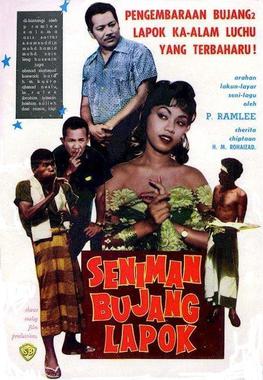
Critically-acclaimed P. Ramlee comedy film of the 1960s.


            Seniman Bujang Lapok is a 1961 Malay comedy film directed by the famed P. Ramlee of Malaysian origin. P. Ramlee is considered to be a national pride (Wahab, 2014, p. 1) however it is unfortunate that he is not recognized as such until his passing (that will be a story for another time).The film title translates to ‘The Downtrodden Bachelor Artistes’ and the film is a pastiche of the late 1950s/early 1960s Malay film industry. The plot centers upon the main cast Ramli, Sudin and Ajis seeking to land acting jobs and enter the film business, thus viewers get a glimpse of a fictionalized look at the behind-the-scenes 1960s Malay film-making procedure as the story unfolds.

Before I begin analyzing the social context of Seniman Bujang Lapok (P. Ramlee, 1961), it is important to note that P. Ramlee tends to draw inspiration for his songs and films from his personal life and milieu (Aljunied, 2005, p. 4). Now I shall discuss the salient social issues exhibited throughout this movie. 

At the very beginning of the film, viewers watch on as a truck is driven through a town and then through the Malay-populated countryside. The truck passes by the ‘Bujang Lapok’ trio sitting at a nearby coffee shop when suddenly one of its tires burst. Sudin is alarmed and instantaneously hides under the table as he is reminded of the time when the Japanese occupied the country and bomb attacks would occur. That was an example of the social-psychological effect that the war has had on the rural Malays and it was shown through Sudin’s phobia of bombings (Aljunied, 2005, p. 10).

Another more evident effect of the post-war Malay society is the disruption of education. This is exemplified when the trio goes for a job interview and they are asked about their qualifications. Ramli reveals that he only attended Malay school till standard 5 and English school till standard 4 and a half, and the extra ‘half’ is due to the Japanese occupying the country and replacing the existing British-implemented curriculum with their own (Kratoska, 1997, p. 123).

The next social issue I would like to highlight is unemployment and poverty. The ‘Bujang Lapok’ trio were apparent portrayals of Malay poverty and unemployment hence their desire to acquire a job and improve their situation. The trio is shown to have difficulty forking out money for the drinks they ordered at the coffee shop as well as the transportation fare to the film studio at Jalan Ampas. Ramli is seen pulling out his pants from under his pillow and 2 bricks but it just goes to show that the trio is so poor that they cannot afford an iron (Aljunied, 2005, p. 12). When the trio exits their room, Ramli meets with Salmah, the object of his affections, and is offered some money in which he shamefully accepts out of desperation as it is widely believed that the Quran charges the husband with the role of being the breadwinner (Sondy, 2014, p. 74).

Another social issue that is highlighted is the distorted understanding of Islamic teachings. There is the issue of polygamy which is illustrated in a scene in which a man is caught dancing with another woman by his wife. The man feigned innocence, citing the Quran saying that a Muslim man can have up to 4 wives (Rahman, 1980, p. 451), to which his wife sarcastically remarks, “Ooh, in regards of marriage, you follow the teachings of Islam! Why don’t you follow the teachings of Islam when it comes to prayers and fasting then?”.

            Throughout this review, I have pointed out some social issues present in the movie that reflect the 1950s/1960s Malay community in Singapore. The social-psychological effects of the Japanese occupation, the disruption of education, unemployment and poverty as well as the distorted understanding of Islamic teachings mirrored the struggle and anxieties faced by the rural Malays back then. However these problems were addressed rather lightheartedly in this film. I would definitely recommend watching the other installments of the ‘Bujang Lapok’ series if you would like to see similar comedic antics.


BIBLIOGRAPHY

Aljunied, S. (2005). Films as Social History — P. Ramlee’s “Seniman Bujang Lapok” and Malays in Singapore (1950s–60s). The Heritage Journal, 2, 1-21. Retrieved July 27, 2014, from http://profile.nus.edu.sg/fass/mlsasmk/stf_mlsasmk.htm

Kratoska, P. H. (1997). The Japanese Occupation of Malaya 1941-1945. Honolulu, Hawai'i: University of Hawai'i Press.

Rahman, F. (Jul., 1980). A Survey of Modernization of Muslim Family Law. International Journal of Middle East Studies, Vol. 11, No. 4, pp. 451-465.

Sondy, A. D. (2014). The Crisis of Islamic Masculinities . New York: Bloomsbury.


Wahab, M. S. (2014, July 8). Postcard memories of the late P. Ramlee. News Straits Times Online, p. 1.

Friday, July 18, 2014

HUGO


            Hugo (Martin Scorsese, 2011) is a film based on the illustrated novel The Invention of Hugo Cabret by Brian Selznick. It tells the fictional tale of an orphaned boy named Hugo Cabret who secretly resides within the walls of Gare Montparnasse train station in the 1930s. He unceremoniously takes over his uncle’s job of clock-keeping at the station. Concurrently, he steals mechanical parts from the station’s toy shop to continue his late father’s legacy of fixing an automaton which was found abandoned at his workplace. One day, he is caught red-handed by the shop owner that will later be revealed as an antiquated filmmaker in which his dad was an avid supporter of.

This antiquated filmmaker, is none other than the renowned cinema pioneer Georges Méliès. He is referred to as the “Father of special effects” for creating the first on-screen double exposure, the split screen and the dissolve (King, 2011). He utilizes classic stage illusion which he learnt as a magician in many of his early films; vanishing acts are made possible by stopping the camera and then introducing new props and actors before starting it up again (Kehr, 2008). These special effects were considered spectacular to the viewers of the time.

The literary aspect of the film which comprises of the plot, characters and setting is the attractive element of the historical drama movie. Despite the fact that Hugo and this whole story centred around him is fabricated, it is very easy to sympathize with his predicament and it would be intriguing to find out how meeting Georges Méliès would change his life for better or for worse. Apart from that, the events of the story take place in 1931 Paris (Selznick, 2011, p. 35). This way the audience will be able to familiarize themselves with the Parisian culture of the early 1930s in which Méliès was a part of.

Apart from that, the dramatic aspect of the film such as the acting, sets, costumes and make up visually enhances the viewing experience. Apart from putting together a convincing 1931 Parisian society, the viewers also get to see flashback scenes regarding the birth, height and eventual decline of Méliès’ past filmmaking career. It began with the Lumière  Brothers’ refusal to sell him their Cinematographe (Walters, 2002), buying a primitive projector off someone and building his own camera (Kehr, 2008), constructing his own glass-enclosed film studio, producing movies with self-made sets, props, costumes and equipping them with his inventor-know-how and magician skills (Woerner, 2011), and the movies ultimately going out of fashion during the First World War and having to sell them to be turned into boot heels for soldiers to contribute to the war effort (Woerner, 2011).

Needless to say, the scenario of a mainstream film is much neater and simplified than that of the actual historical events due to duration constraint. However, Hugo’s alterations of the facts are reasonable and will allow the viewers to exit the cinema with a decent impression of Méliès’ career (Thompson, 2011).


So if you are anything like me and can hardly stay awake during history lessons, this is the perfect movie to watch if you wish to gain some insight into this celebrated historical figure of the cinematic world. Hugo may be known as a 3D film but it does not exhaust the use of computer-generated graphics (CGI) or neglect cinematography aesthetics as there are just as many actual camera movements to go with the special effects. Moreover, Scorsese has done a superb job in striking that balance despite that this film is only his first venture into 3D. Georges Méliès could not ask for a better tribute. 


BIBLIOGRAPHY

Kehr, D. (2008, March 18). GEORGES MéLIèS: FIRST WIZARD OF CINEMA. The New York Times.

King, S. (2011, November 28). 'Hugo' revives interest in Georges Melies. Los Angeles Times.

Selznick, B. (2011). The Director and His Vision. THE HUGO MOVIE COMPANION: A Behind the Scenes Look at How a Beloved Book Became a Major Motion Picture (). New York : Scholastic Press .

Thompson, K. (2011, December 7). HUGO: Scorsese’s birthday present to Georges Méliès. . Retrieved July 18, 2014, from http://www.davidbordwell.net/blog/2011/12/07/hugo-scorseses-birthday-present-to-georges-melies/

Walters, J. (2002, March 1). Pioneers: Georges Méliès. . Retrieved July 18, 2014, from http://www.earlycinema.com/pioneers/melies_bio.html


Woerner, M. (2011, November 23). What Martin Scorsese's Hugo Taught Us About the Grandfather of Science Fiction Film, Georges Méliès. . Retrieved July 18, 2014, from http://io9.com/5861647/what-hugo-taught-us-about-the-grandfather-of-science-fiction-film-georges-melies