Sunday, July 27, 2014

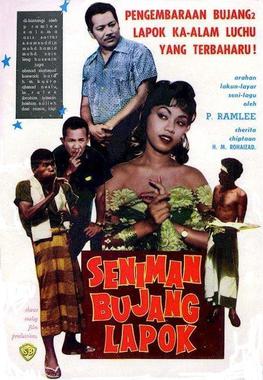
Critically-acclaimed P. Ramlee comedy film of the 1960s.


            Seniman Bujang Lapok is a 1961 Malay comedy film directed by the famed P. Ramlee of Malaysian origin. P. Ramlee is considered to be a national pride (Wahab, 2014, p. 1) however it is unfortunate that he is not recognized as such until his passing (that will be a story for another time).The film title translates to ‘The Downtrodden Bachelor Artistes’ and the film is a pastiche of the late 1950s/early 1960s Malay film industry. The plot centers upon the main cast Ramli, Sudin and Ajis seeking to land acting jobs and enter the film business, thus viewers get a glimpse of a fictionalized look at the behind-the-scenes 1960s Malay film-making procedure as the story unfolds.

Before I begin analyzing the social context of Seniman Bujang Lapok (P. Ramlee, 1961), it is important to note that P. Ramlee tends to draw inspiration for his songs and films from his personal life and milieu (Aljunied, 2005, p. 4). Now I shall discuss the salient social issues exhibited throughout this movie. 

At the very beginning of the film, viewers watch on as a truck is driven through a town and then through the Malay-populated countryside. The truck passes by the ‘Bujang Lapok’ trio sitting at a nearby coffee shop when suddenly one of its tires burst. Sudin is alarmed and instantaneously hides under the table as he is reminded of the time when the Japanese occupied the country and bomb attacks would occur. That was an example of the social-psychological effect that the war has had on the rural Malays and it was shown through Sudin’s phobia of bombings (Aljunied, 2005, p. 10).

Another more evident effect of the post-war Malay society is the disruption of education. This is exemplified when the trio goes for a job interview and they are asked about their qualifications. Ramli reveals that he only attended Malay school till standard 5 and English school till standard 4 and a half, and the extra ‘half’ is due to the Japanese occupying the country and replacing the existing British-implemented curriculum with their own (Kratoska, 1997, p. 123).

The next social issue I would like to highlight is unemployment and poverty. The ‘Bujang Lapok’ trio were apparent portrayals of Malay poverty and unemployment hence their desire to acquire a job and improve their situation. The trio is shown to have difficulty forking out money for the drinks they ordered at the coffee shop as well as the transportation fare to the film studio at Jalan Ampas. Ramli is seen pulling out his pants from under his pillow and 2 bricks but it just goes to show that the trio is so poor that they cannot afford an iron (Aljunied, 2005, p. 12). When the trio exits their room, Ramli meets with Salmah, the object of his affections, and is offered some money in which he shamefully accepts out of desperation as it is widely believed that the Quran charges the husband with the role of being the breadwinner (Sondy, 2014, p. 74).

Another social issue that is highlighted is the distorted understanding of Islamic teachings. There is the issue of polygamy which is illustrated in a scene in which a man is caught dancing with another woman by his wife. The man feigned innocence, citing the Quran saying that a Muslim man can have up to 4 wives (Rahman, 1980, p. 451), to which his wife sarcastically remarks, “Ooh, in regards of marriage, you follow the teachings of Islam! Why don’t you follow the teachings of Islam when it comes to prayers and fasting then?”.

            Throughout this review, I have pointed out some social issues present in the movie that reflect the 1950s/1960s Malay community in Singapore. The social-psychological effects of the Japanese occupation, the disruption of education, unemployment and poverty as well as the distorted understanding of Islamic teachings mirrored the struggle and anxieties faced by the rural Malays back then. However these problems were addressed rather lightheartedly in this film. I would definitely recommend watching the other installments of the ‘Bujang Lapok’ series if you would like to see similar comedic antics.


BIBLIOGRAPHY

Aljunied, S. (2005). Films as Social History — P. Ramlee’s “Seniman Bujang Lapok” and Malays in Singapore (1950s–60s). The Heritage Journal, 2, 1-21. Retrieved July 27, 2014, from http://profile.nus.edu.sg/fass/mlsasmk/stf_mlsasmk.htm

Kratoska, P. H. (1997). The Japanese Occupation of Malaya 1941-1945. Honolulu, Hawai'i: University of Hawai'i Press.

Rahman, F. (Jul., 1980). A Survey of Modernization of Muslim Family Law. International Journal of Middle East Studies, Vol. 11, No. 4, pp. 451-465.

Sondy, A. D. (2014). The Crisis of Islamic Masculinities . New York: Bloomsbury.


Wahab, M. S. (2014, July 8). Postcard memories of the late P. Ramlee. News Straits Times Online, p. 1.

Friday, July 18, 2014

HUGO


            Hugo (Martin Scorsese, 2011) is a film based on the illustrated novel The Invention of Hugo Cabret by Brian Selznick. It tells the fictional tale of an orphaned boy named Hugo Cabret who secretly resides within the walls of Gare Montparnasse train station in the 1930s. He unceremoniously takes over his uncle’s job of clock-keeping at the station. Concurrently, he steals mechanical parts from the station’s toy shop to continue his late father’s legacy of fixing an automaton which was found abandoned at his workplace. One day, he is caught red-handed by the shop owner that will later be revealed as an antiquated filmmaker in which his dad was an avid supporter of.

This antiquated filmmaker, is none other than the renowned cinema pioneer Georges Méliès. He is referred to as the “Father of special effects” for creating the first on-screen double exposure, the split screen and the dissolve (King, 2011). He utilizes classic stage illusion which he learnt as a magician in many of his early films; vanishing acts are made possible by stopping the camera and then introducing new props and actors before starting it up again (Kehr, 2008). These special effects were considered spectacular to the viewers of the time.

The literary aspect of the film which comprises of the plot, characters and setting is the attractive element of the historical drama movie. Despite the fact that Hugo and this whole story centred around him is fabricated, it is very easy to sympathize with his predicament and it would be intriguing to find out how meeting Georges Méliès would change his life for better or for worse. Apart from that, the events of the story take place in 1931 Paris (Selznick, 2011, p. 35). This way the audience will be able to familiarize themselves with the Parisian culture of the early 1930s in which Méliès was a part of.

Apart from that, the dramatic aspect of the film such as the acting, sets, costumes and make up visually enhances the viewing experience. Apart from putting together a convincing 1931 Parisian society, the viewers also get to see flashback scenes regarding the birth, height and eventual decline of Méliès’ past filmmaking career. It began with the Lumière  Brothers’ refusal to sell him their Cinematographe (Walters, 2002), buying a primitive projector off someone and building his own camera (Kehr, 2008), constructing his own glass-enclosed film studio, producing movies with self-made sets, props, costumes and equipping them with his inventor-know-how and magician skills (Woerner, 2011), and the movies ultimately going out of fashion during the First World War and having to sell them to be turned into boot heels for soldiers to contribute to the war effort (Woerner, 2011).

Needless to say, the scenario of a mainstream film is much neater and simplified than that of the actual historical events due to duration constraint. However, Hugo’s alterations of the facts are reasonable and will allow the viewers to exit the cinema with a decent impression of Méliès’ career (Thompson, 2011).


So if you are anything like me and can hardly stay awake during history lessons, this is the perfect movie to watch if you wish to gain some insight into this celebrated historical figure of the cinematic world. Hugo may be known as a 3D film but it does not exhaust the use of computer-generated graphics (CGI) or neglect cinematography aesthetics as there are just as many actual camera movements to go with the special effects. Moreover, Scorsese has done a superb job in striking that balance despite that this film is only his first venture into 3D. Georges Méliès could not ask for a better tribute. 


BIBLIOGRAPHY

Kehr, D. (2008, March 18). GEORGES MéLIèS: FIRST WIZARD OF CINEMA. The New York Times.

King, S. (2011, November 28). 'Hugo' revives interest in Georges Melies. Los Angeles Times.

Selznick, B. (2011). The Director and His Vision. THE HUGO MOVIE COMPANION: A Behind the Scenes Look at How a Beloved Book Became a Major Motion Picture (). New York : Scholastic Press .

Thompson, K. (2011, December 7). HUGO: Scorsese’s birthday present to Georges Méliès. . Retrieved July 18, 2014, from http://www.davidbordwell.net/blog/2011/12/07/hugo-scorseses-birthday-present-to-georges-melies/

Walters, J. (2002, March 1). Pioneers: Georges Méliès. . Retrieved July 18, 2014, from http://www.earlycinema.com/pioneers/melies_bio.html


Woerner, M. (2011, November 23). What Martin Scorsese's Hugo Taught Us About the Grandfather of Science Fiction Film, Georges Méliès. . Retrieved July 18, 2014, from http://io9.com/5861647/what-hugo-taught-us-about-the-grandfather-of-science-fiction-film-georges-melies